
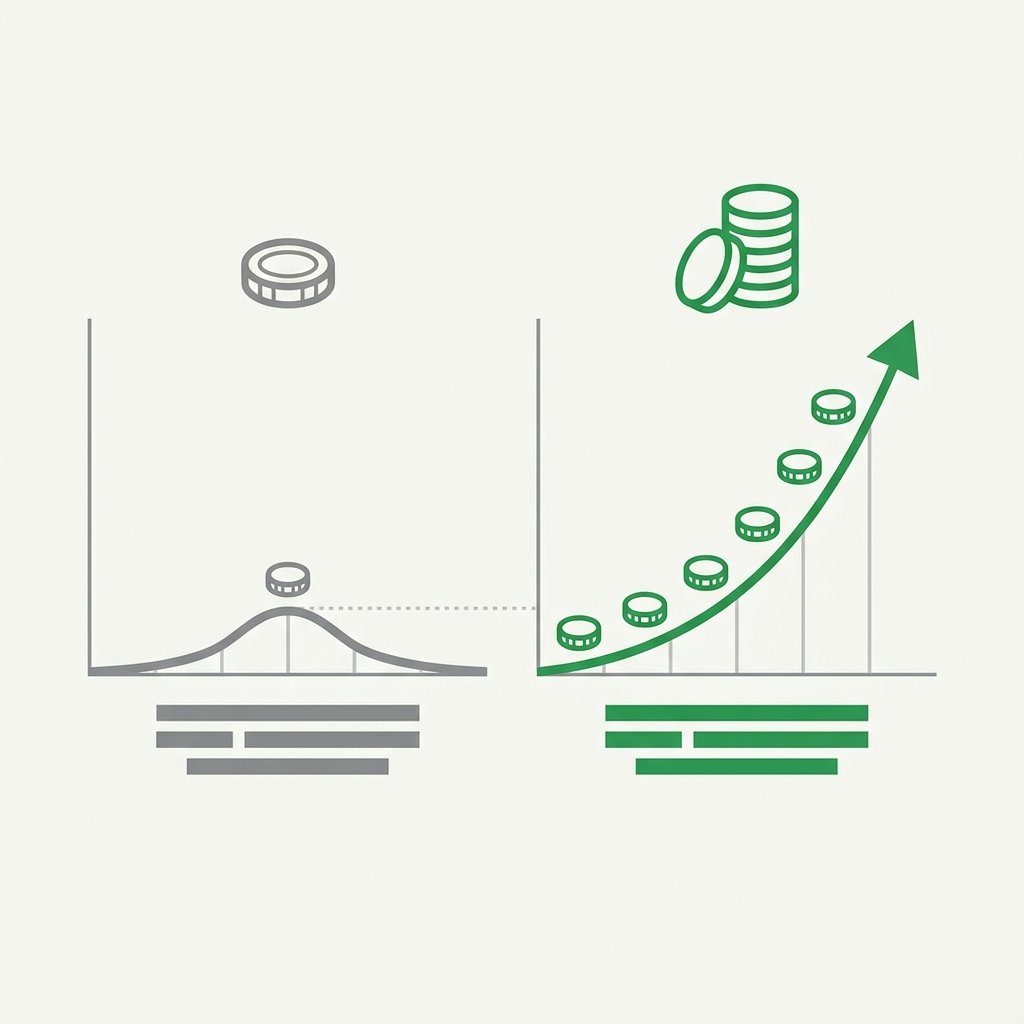
A common question from new investors: is it better to invest $100 once and see how it goes, or commit to investing $100 every month going forward? The honest answer is that the second approach does dramatically more for your long-term wealth — and the reason comes down to a concept called compounding.
The math behind consistency. A single $100 investment, left alone for decades, can grow meaningfully thanks to compounding — but it’s still just one $100 seed. Contributing $100 every month means you’re planting a new seed every 30 days, each one with its own years to compound. Over a long time horizon, the total contributed matters far more to your ending balance than how well any single contribution happened to be timed.
Why “waiting until I have more to invest” backfires. It’s tempting to wait until you have a bigger lump sum before starting — but every month you wait is a month of lost compounding time that can’t be recovered later. Starting small and immediately beats waiting for “enough,” almost every time, because time in the market matters more than the size of any individual contribution.
Dollar-cost averaging — the built-in benefit of monthly investing. When you invest a fixed amount on a regular schedule, you automatically buy more shares when prices are lower and fewer when prices are higher, without having to time anything yourself. This smooths out the impact of market volatility over time and removes the emotional guesswork of “is now a good time to buy.”
A realistic example of the gap. Someone who invests $100 once and never again will end up with meaningfully less than someone who invests $100 monthly for even a few years — not because the first $100 performed worse, but because consistent monthly investing means dramatically more total money working for you over time, plus more individual contributions benefiting from years of compounding.
How to make monthly investing actually happen:
- Automate the contribution on payday, before you have a chance to spend the money elsewhere
- Treat it like a fixed bill, not a “leftover money” decision
- Start at whatever amount is genuinely sustainable — $25 or $50 a month consistently beats $100 a month that you abandon after three months
- Increase the amount gradually as your income grows, rather than waiting to “start big”
Bottom line: a single $100 investment is a fine start, but it’s the monthly habit — not the initial amount — that actually determines whether you build real wealth over the next decade.
This article is educational content, not personalized financial or investment advice. Consider talking to a licensed financial advisor before making investment decisions.

2 Comments
Pingback: ETF Vs. Index Mutual Fund: Which Should Beginners Choose In 2026? | Gowithtrendy.com
Pingback: The 5 Warning Signs You're Scaling Your Startup At An Unsustainable Pace | Gowithtrendy.com